Radical 土
6 strokes
1. earth 土 (54a) + also 也 (8) = ground 地
2. earth 土 (54a) + also 也 (8) = -ly 地
Now, here we have a character with two meanings, and two pronunciations to go with them! Whenever this happens (there are ten such characters in this book), we will simply provide two stories. however, one will be set in the Wild West, and one will be set on a large spaceship. No other characters, apart from these ten, will use either of these settings. So whenever you see a character and remember the story to go with it, if the setting is the Wild West or a spaceship, this will remind you that there is also another story (in the other setting). Of course, which meaning (and pronunciation) is appropriate will be for you to decide, depending on the context. this is like seeing the word “bow” in english: until you know the context (tying shoelaces? aboard a ship? archery?) you won’t know which meaning, or which pronunciation, is appropriate.
The second meaning, “-ly”, is our name for how 地 helps to qualify verbs, like the “-ly” ending of adverbs in english.
You may wonder which of the two meanings to use in future equations. Fortunately this problem doesn’t arise as this character never appears as part of another character.
[地下 (43) dìxià underground]

1.
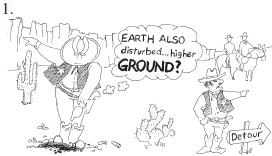
 (A posse is pursuing bandits, and the sheriff dismounts to look at the spent bullets) “the earth has also been disturbed,” he says, “they’re heading for higher ground.” / His dwarf deputy takes a few men on a detour (to head them off at the pass …)
2.
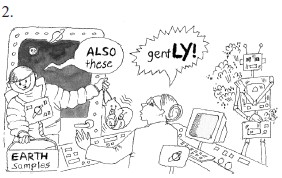
 (The landing party has returned to the spaceship from the planet) “We didn’t just get samples of earth, we also found some great alien artefacts, so treat them gentle.” “Gently,” corrects the Chief Scientist (who is a stickler for grammar). / “And can somebody go and sort out the robot— he’s miserable because he’s got so dusty” (collecting the earth samples).
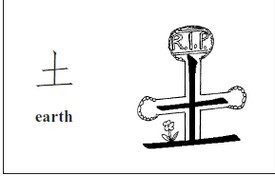

Once again (as in 夫, Character 49), the second stroke of this character is longer than the first. this time it really matters, for there is another character which looks just like 土, except that the first stroke is longer than the second (士, Character 487a).
When used as the left-hand side of other characters, 土 gets squashed so that the last stroke slopes upwards (see the next character for an example).