Radical 人
3 strokes
個
tent 人 (19b) + stick 丨 (19a) = number of items 个
Notice that in this character the two building blocks are one above the other, rather than being side by side.
This is a measure word. In english we don’t say “two breads”; we say “two loaves of bread” or “two slices of bread”. Words such as “slice” are called measure words, and all nouns in Chinese have to use measure words for counting. There are dozens of measure words for different types of things (see Character 188 for an example), but 个 is an all-purpose measure word which can be used with most nouns.

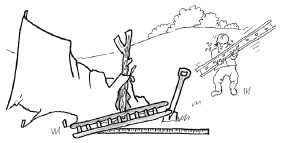
He tried to keep the tent up with a stick but it fell down, so he tried a number of items he had lying around. / The dwarf got so fed up with the tent falling on him that he went and got an iron girder to make sure it didn’t happen again!
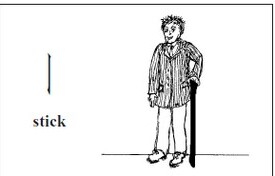

This is a fragment. Fragments are only ever parts of characters; they never appear on their own as characters, and so they do not have pronunciations. Fragments are always printed in gray. We only give them meanings so that we can use them in equations and stories.
A vertical stroke occurs in many characters of course, but we will not treat every vertical stroke as a “stick”. For example, it seems more natural to treat 十 “ten” as a basic building block, rather than trying to decompose it into “one” plus “stick”. Instead, we reserve “stick” for situations where it stands on its own (as in Character 19 below).
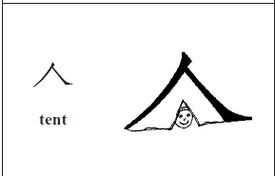

This fragment is found at the top of some characters. It has a symmetrical shape, unlike “person” (12) and “enter” (219a).
The meaning is given in quotes to indicate that the name “tent” is one we have invented for this fragment.
To draw it, draw each stroke downwards (rather than drawing a single stroke in an “up and over” movement).