Radical 口
5 strokes
mouth 口 (5) + nail 丁 (81b) = may 可
The meaning is “may” in the sense of “being permitted to”, but since this is a bit abstract we will cheat here and use a play on words: we will associate this character with Mayday celebrations in an english village, where children dance round a Maypole.
Note that the shaft of the nail is displaced to the right to make room for the mouth.
Some books advocate a different stroke order, where the whole of “nail” is drawn first, and then “mouth”. Occasionally we point out alternative stroke orders (we already mentioned alternatives for Character 127). Sometimes the different versions exist because one is more firmly grounded in the “traditional” way of doing things and one is more “modern”, but in other cases there simply seem to be two accepted ways of writing the character. Where we point out alternatives, either will produce a perfectly well-drawn character and so you can choose which to adopt. All this doesn’t alter the fact that for the overwhelming majority of characters there is a single stroke order which is accepted as being “correct”.
可以 (120) kěyǐ may, be allowed
可是 (30) kěshì but (colloq)

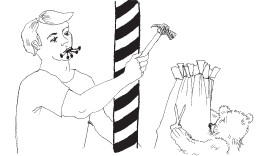
The carpenter holds nails in his mouth while fixing up the May pole for the May celebrations. / Teddy cuts up strips of curtains for the streamers.