Radical 一
1 stroke
This is the simplest character there is, and it’s obviously a basic building block. as such it has a “wheel” story to help you remember the pronunciation. The soundword is “easy” so the pronunciation is “ee” (the pinyin spelling is “yi” but it is pronounced “ee”), and the giant in the story tells you it is pronounced using the first tone.
But, wouldn’t you know it, for the very first character we have a complication with regard to the pronunciation! essentially, the pronunciation is yī (1st tone), but the complication is that in practice the tone for this character varies, depending on the tone of the syllable which follows it. When it is followed by a 4th tone, it is pronounced yí (2nd tone), and when followed by all other tones it is pronounced yì (4th tone). When it is on its own, or in a string of numbers, it reverts to yī (1st tone). This sort of change only happens for one other character in this book, which we shall meet shortly.
For this first character a stroke order diagram seems rather superfluous! Simply write the stroke in a left to right direction. The large character is printed in a typical printed typeface. Don’t worry about the little lump at the right-hand end of the stroke: this is like a “serif ” (the small horizontal line you might find at the bottom of letters like “h” in some typefaces in english) and can be ignored. The stroke order diagrams in the boxes show you what a hand-drawn character will look like.

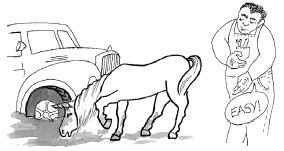
/ One of the huge wheels of the truck was stuck fast in the thick mud and the unicorn had blunted his horn trying to shift it. They called in the giant who took one look at it and said, “This will be easy.”